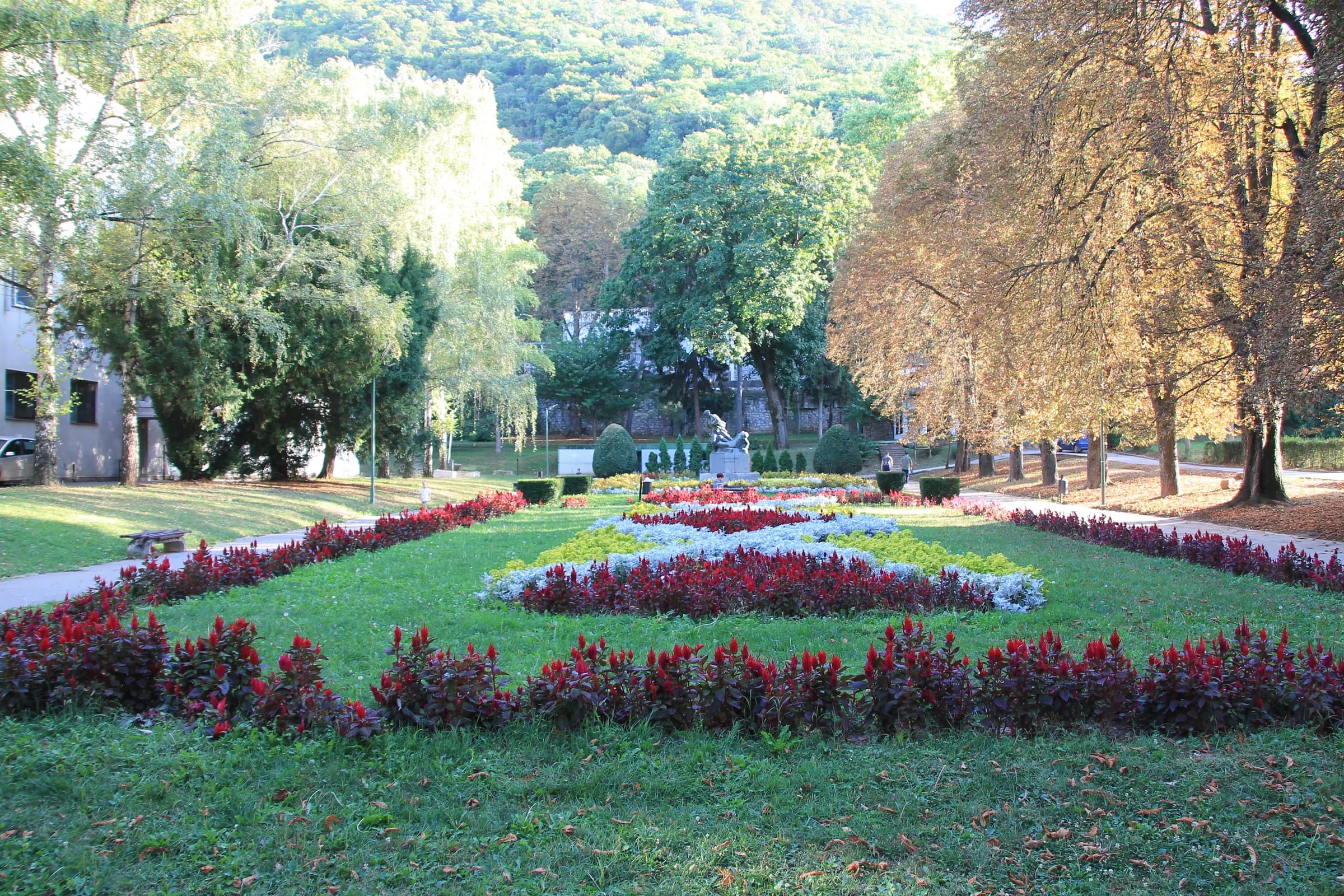
Photo: Ванилица · CC BY-SA 4.0

- Spring temperature
- 38°C
- From Belgrade
- 245 km
- By car
- 2h 35m
- Bus
- Direct from Belgrade
Introduction
Why Visit Niška Banja
Niška Banja is a thermal spa on the edge of Niš in southern Serbia, 9 km from the city centre and reachable by city bus. Its radon-enriched mineral water rises at around 38°C. The Institute for Treatment and Rehabilitation specialises in cardiovascular and rheumatic conditions, and day visitors can use the public thermal pool without being patients.
Niška Banja is a historic thermal spa on the edge of Niš, in southern Serbia, and one of the country's best-known health resorts — the third most visited spa in Serbia after Vrnjačka Banja and Sokobanja. Its defining feature is its warm, radon-enriched mineral water, which rises at around 38°C and has been used since Roman times; today the town's Institute for Treatment and Rehabilitation is a specialist centre for cardiovascular and rheumatic conditions. What makes Niška Banja unusually easy for a visitor is its location: it sits just 9 km from the centre of Niš, reachable by city bus, so you can combine thermal bathing with one of Serbia's most historic cities. Day visitors can use the public thermal pool and wellness centre without being patients, which makes it far more accessible than Serbia's institute-only spas.
History
The Spa of Emperor Constantine
Few Serbian spas can claim a pedigree like Niška Banja's. The Romans built public baths (thermae) here as early as the 2nd century, and the mineral water was prized enough to be carried the short distance to Mediana, the luxurious residence of Emperor Constantine the Great — who was born in nearby Niš — for use in his imperial villa. The spa is first mentioned in written records in the 5th century, and its reputation survived every empire that followed: under Ottoman rule it is said to have served as a resting place for Sultan Suleiman, and in modern times it became a favourite of Serbian kings, earning it the double billing of 'the spa of Emperor Constantine and of Serbian kings'. Traces of that long history — Roman and early Byzantine remains, old bathhouses, the King's Spring captured in the historic Stari Kupatilo building — are still part of the town's fabric, giving a soak here a genuine sense of continuity with the ancient world.
Treatments
Radon Water & the Heart
Niška Banja's water is what sets it apart: it emerges from several springs as a slightly mineralised, alkaline-earth homeotherm at 36–39°C, naturally enriched with radon gas, and it is this radon content — rather than heat alone — that underpins the spa's medical reputation. The Institute for Treatment and Rehabilitation, often called the Radon Institute, is a serious clinical operation with some 560 beds and departments for cardiology, rheumatology, orthopaedic surgery and rehabilitation, and it is one of Serbia's leading centres for cardiovascular disease, high blood pressure and rheumatic conditions, as well as for recovery after fractures, joint operations and spinal surgery. The radon is central to how the water is used therapeutically; as with any radon spa, exposure is a natural part of the treatment, and the doses involved in bathing are generally considered low, though it remains, by its nature, a radioactive spa. Importantly for travellers, you do not have to be a patient to benefit: the thermal swimming pool, the Sense wellness and spa centre, saunas and jacuzzis are open to day visitors for a fee.
Nature & Setting
Niš, Nišville & the Deep History Nearby
Niška Banja sits at the foot of Suva Planina, wrapped in the Koritnjak park-forest — more than 70 hectares of shaded walking trails that give the resort its clean air and calm. But the real draw of the surroundings is Niš itself, just 9 km away and one of the oldest and most characterful cities in the Balkans. Its Ottoman fortress by the Nišava river, the macabre Skull Tower (Ćele Kula, built from the skulls of Serbian rebels), the ruins of Constantine's Mediana villa and the atmospheric Tinkers' Alley of bars and grills all make for a rich day out. Niš is also a festival city: the internationally regarded Nišville Jazz Festival fills the fortress every August, and if you can time your stay to coincide, a spa-and-jazz combination is hard to beat. Between the mountain trails, the ancient sites and the city's food and music, Niška Banja works as much as a base for exploring as a cure in itself.
Where to Stay
Where to Stay in Niška Banja
Accommodation in Niška Banja spans a wider range than most Serbian spas. The Institute runs its own large residential units — Radon, Zelengora and Terme — which combine rooms with full therapy blocks for guests on treatment programmes, while a cluster of independent hotels (among them Partizan, Srbija and Ozren) and a great many private villas and apartments serve ordinary tourists. Prices are low by Western standards, and because the resort caters both to medical guests and to holidaymakers from Niš and beyond, you can pick anything from a clinical full-board stay to a simple room near the pool. The town gets busy in summer, when the outdoor pool and the shade of the park draw crowds, so it is worth booking ahead for July and August; the rest of the year it is quieter and cheaper. Compare hotels and check current availability on Booking.com before you travel.
Getting There
How to Get to Niška Banja
Getting to Niška Banja is refreshingly simple. It lies about 245 km south of Belgrade — roughly two and a half hours on the E75 motorway — but its great advantage is proximity to Niš, only 9 km away. City bus line 1 runs from central Niš to the spa in about twenty minutes, and taxis cover the short distance cheaply, so you do not need a car at all if you base yourself in the city. Niš has its own airport, Constantine the Great, with flights from a growing list of European cities, which makes Niška Banja one of the easiest Serbian spas to reach by air — you can be soaking in the thermal pool within half an hour of landing. The spa sits just off the main Niš–Sofia road and is well signposted from the E80 for those arriving by car.
Visitor Tips
Tips for Western Visitors
Niška Banja rewards travellers who treat it as a pairing with Niš rather than a standalone destination. You can visit the thermal pool and wellness centre as a day guest without committing to a treatment programme, which makes it an easy, inexpensive add-on to a city break — bring swimwear and flip-flops. The radon in the water tends to prompt questions from first-time visitors: it is genuinely a radioactive spa, but radon balneotherapy has a long clinical history here and the exposure from bathing is generally regarded as low, so a soak or two is not something most visitors need to worry about. English is spoken partially, better in Niš than at the older spa facilities, so a translation app helps, and it is wise to carry some cash. Spring and autumn bring the most comfortable weather; summer is lively and hot, and best if you want the outdoor pool and the Nišville festival.
FAQ
Frequently Asked Questions
Is the radon water at Niška Banja safe?
Radon is the basis of the spa's therapy and has been used here clinically for decades. It is a genuinely radioactive spa, but the exposure involved in bathing is generally considered low; radon therapy is a recognised, if debated, balneological treatment.
What does Niška Banja treat?
Its warm, radon-rich water is used mainly for cardiovascular disease and high blood pressure, rheumatic conditions, and rehabilitation after fractures, joint operations and spinal surgery.
Can I visit without being a patient?
Yes. The thermal pool, the Sense wellness centre, saunas and jacuzzis are open to day visitors for a fee — you do not need to be admitted to the Institute.
How do I get to Niška Banja from Niš?
City bus line 1 runs from central Niš to the spa in about 20 minutes, and taxis cover the 9 km cheaply. Niš also has its own airport.
How hot is the water?
The main spring rises at about 38–39°C — comfortably warm rather than scalding — and the pools are kept at pleasant bathing temperatures.
Related