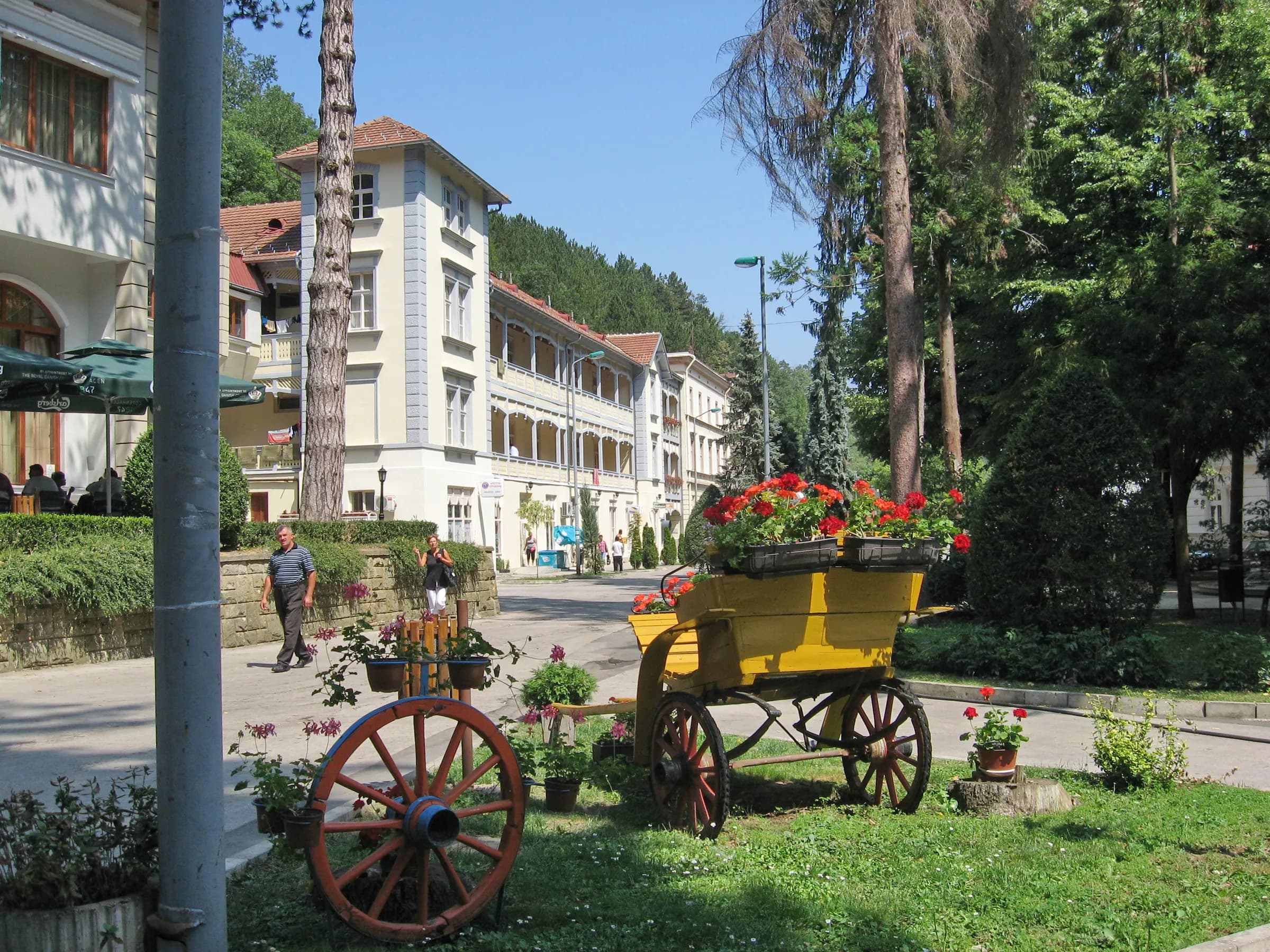
Photo: Sonjabgd · CC BY-SA 3.0

- Spring temperature
- 42°C
- From Belgrade
- 210 km
- By car
- 3h
- Bus
- Direct from Belgrade
Introduction
Why Visit Ribarska Banja
Ribarska Banja is a thermal spa in central Serbia, 210 km from Belgrade and about 35 km from Kruševac, at around 540 m on Mount Jastrebac. Six sulphurous springs reach up to 42°C. It is one of Serbia's oldest spas and works today mainly as a rehabilitation centre for bones and joints.
Ribarska Banja is one of Serbia's oldest spas, tucked into the wooded slopes of Mount Jastrebac at around 540 m, about 35 km from the historic town of Kruševac. Its six thermal springs — sulphurous mineral water reaching up to 42°C — have been used since Roman and medieval times, and its long list of royal guests earned it the nickname of a 'royal spa'. Today it is best known as a rehabilitation centre for bones and joints, but its combination of warm healing water and crisp, clean sub-mountain air also makes it a genuine rest cure. Quieter and greener than the big-name resorts, it suits travellers who want mountain calm, thermal bathing and a strong sense of history rather than crowds or nightlife.
History
A Spa Fit for Kings
Ribarska Banja's history runs remarkably deep. A Roman fort once stood on the site, and the medieval record ties the springs to the founders of the Serbian state: the surrounding Zagrlata county was granted to Stefan Nemanja, founder of the Nemanjić dynasty, and legend holds that Princess Milica and her ladies kept their beauty in these waters. The spa even owes its name — 'Fisherman's Spa' — to the fishermen who once caught prized trout here for Prince Lazar. It was among the first six Serbian spas rebuilt in 1833 under Prince Miloš, and it flourished under the Karađorđević kings: King Petar I was a devoted regular whose patronage drove much of its early-20th-century development. Something of that royal past is still on offer — visitors can take a 'pearl bath' in the very tub once used by Queen Draga, a small piece of living history you will not find at many spas.
Treatments
Thermal Springs for Bones & Joints
The natural cure at Ribarska Banja rests on six thermal springs of sulphurous mineral water, the warmest reaching around 42°C and the others ranging from about 25°C to 37°C, complemented by a single cold spring of around 16°C used for drinking. The waters are rich in sulphur, calcium and magnesium, and the resort's Special Institute for rehabilitation puts them to work chiefly on the musculoskeletal system: it treats almost all bone diseases, the three main forms of rheumatism, spinal deformities, joint injuries, degenerative conditions and paralysis, and it is a place doctors commonly recommend for recovery after fractures and orthopaedic surgery. Therapy combines bathing, drinking and rinsing of the throat, nose and eyes with physical therapy in indoor and outdoor pools, including a semi-Olympic pool. Alongside the medical programmes there is a full wellness offer — massages, saunas, a steam bath, a salt room and a gym — so the spa works equally well for straightforward relaxation. As ever, these are rehabilitative and restorative uses rather than cures.
Nature & Setting
Mount Jastrebac, Kruševac & Župa Wine
Set high on Veliki Jastrebac and ringed by forest, Ribarska Banja is as much a climatic retreat as a thermal one — the pure mountain air and quiet were historically considered part of the cure, and the surrounding slopes are laced with walking trails, including the popular hike to the Pogled viewpoint. The wider area rewards exploration: nearby Kruševac was the capital of Prince Lazar's medieval Serbia and preserves the elegant Lazarica church and fortress ruins, while St Roman's Monastery holds the heart of Count Rayevsky, the Russian nobleman said to have inspired Vronsky in Anna Karenina. To the south lies the Aleksandrovačka Župa, one of Serbia's oldest wine regions, at its liveliest during the autumn grape harvest and its wine festival, and the South Morava offers gentle rafting. It is an unusually rich hinterland for a small spa, blending mountain nature, medieval history and wine country within an easy drive.
Where to Stay
Where to Stay in Ribarska Banja
Accommodation at Ribarska Banja centres on the Institute's own facilities and a well-regarded spa hotel, supplemented by apartments and private rooms in and around the resort. Guests on treatment programmes stay full-board with the Institute, while independent visitors will find comfortable hotel and apartment options that give access to the pools and wellness centre — the resort is small, walkable and set entirely within its forested valley, so wherever you stay you are close to the water. Standards are comfortable rather than luxurious, prices are modest, and the atmosphere is calm and restorative, tuned to guests who have come for their health or for quiet. Summer, when the large outdoor pool opens, is the busiest season and worth booking ahead for; spring and autumn are especially pleasant for the walking. Compare options and check current availability on Booking.com before you travel.
Getting There
How to Get to Ribarska Banja
Ribarska Banja lies about 210 km south of Belgrade, reached easily via the Belgrade–Niš (E75) motorway and then the road west to Kruševac, from where the spa is a further 35 km up into the Jastrebac foothills — roughly three hours in all. Kruševac is the natural gateway, well connected to Belgrade by both motorway and rail, and from there local buses and taxis continue to the spa; the nearest airport is Constantine the Great in Niš, about 70 km away. Because the final stretch climbs into the mountains and public transport onto Jastrebac is limited, a car makes the trip easier and, more to the point, lets you combine Ribarska Banja with Kruševac, the Župa wine country and the hiking trails of Jastrebac. Allow a little extra time for the winding mountain approach.
Visitor Tips
Tips for Western Visitors
Ribarska Banja suits a slower, restorative kind of trip. Don't miss the small royal flourishes — the 'pearl bath' in Queen Draga's original tub is a charming, only-here experience — and take advantage of the wellness centre, salt room and saunas even if you are not on a medical programme. The setting is the real luxury here: pack walking shoes for Jastrebac and plan at least one hike, and consider pairing the spa with a day in Kruševac or the Župa vineyards. English is spoken only partially, so a translation app and a few Serbian phrases help, and you should carry some cash for smaller purchases. The resort is at its best from late spring through autumn, when the mountain weather is mild and the forest is green; summer brings the outdoor pool and the most life, while winters are quiet and cold at this altitude.
FAQ
Frequently Asked Questions
How hot are the springs at Ribarska Banja?
There are six thermal springs; the warmest reaches about 42°C, while the others range from roughly 25°C to 37°C. A separate cold spring (around 16°C) is used for drinking.
What does Ribarska Banja treat?
It specialises in the musculoskeletal system — bone and joint diseases, all forms of rheumatism, spinal deformities and degenerative conditions — and in recovery after fractures and orthopaedic surgery.
Why is it called a royal spa?
It was a favourite of Serbian royalty, especially King Petar I. Visitors can even bathe in a 'pearl bath' using the original bathtub once used by Queen Draga.
How do I get there from Belgrade?
About 210 km (roughly three hours) via the E75 motorway and Kruševac, which lies 35 km away. The nearest airport is Niš, about 70 km distant.
Is it good for a relaxing break rather than treatment?
Yes. Alongside the medical programmes there are pools, massages, saunas, a salt room and mountain hiking, making it a fine quiet retreat.
Related