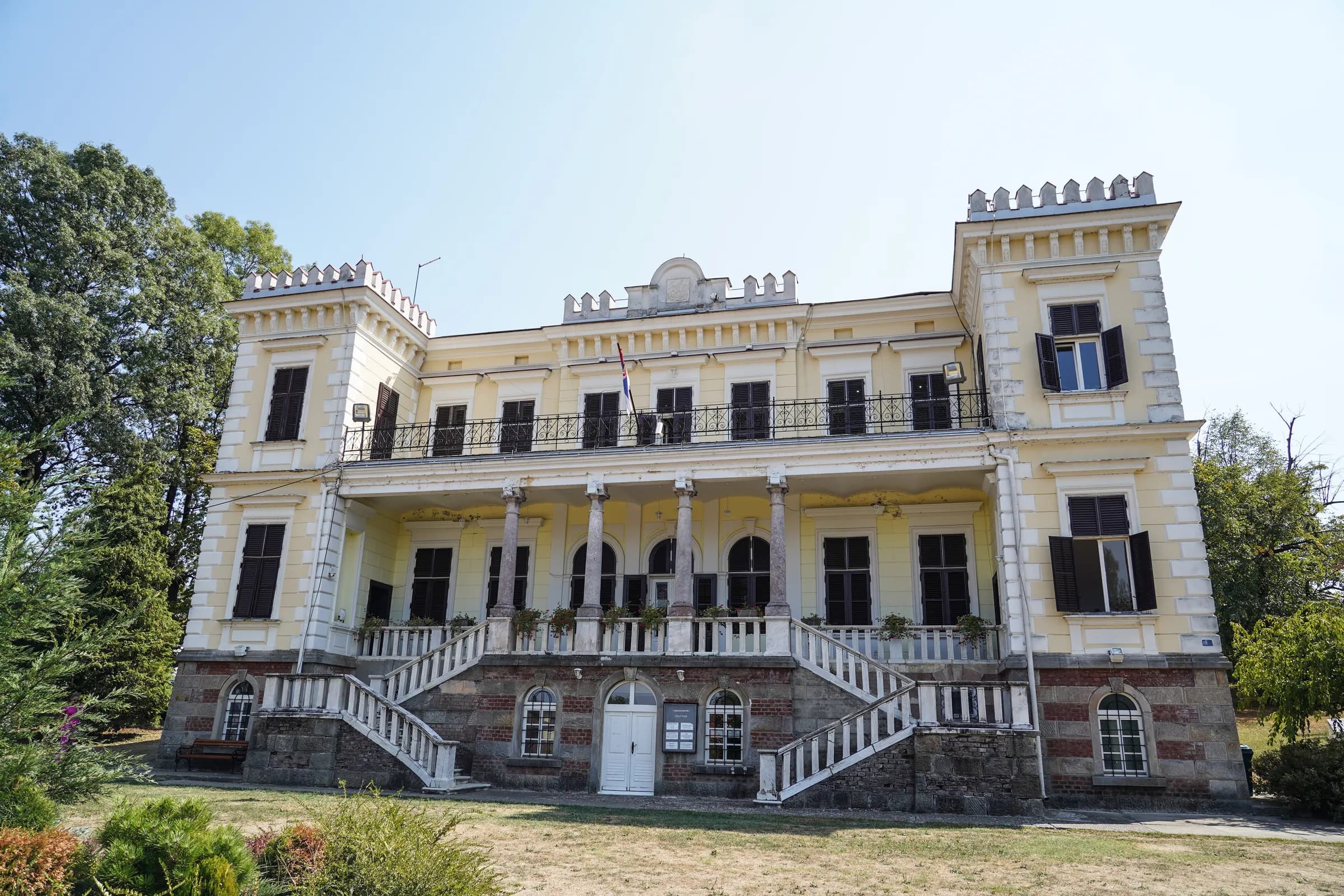
Photo: Sunce Niš · CC BY-SA 4.0

- Spring temperature
- 36.5°C
- From Belgrade
- 200 km
- By car
- 2h 30m
- Bus
- Direct from Belgrade
- Accommodation
- €40–€90/night
Introduction
Why Visit Vrnjačka Banja
Vrnjačka Banja has seven mineral springs, one of them Topla voda at 36.5°C, the temperature of the human body. It is Serbia's largest and most visited spa, running continuously since 1868 and working as a holiday town rather than a treatment institute. The resort lies 200 km south of Belgrade on the northern slopes of Mount Goč.
Vrnjačka Banja is Serbia's largest and most visited spa, a green resort town of parks, bridges and promenades on the northern slopes of Mount Goč, about 200 km south of Belgrade. Its reputation rests on seven mineral springs — one of which, Topla voda, rises at exactly 36.5°C, the temperature of the human body. People have been coming for the water since the Romans built a bathing complex here in the 2nd century, and in its modern form the spa has been running continuously since 1868, which makes its founding society one of the oldest tourist organisations in the Balkans.
What sets it apart from Serbia's quieter banje is that it is a genuine resort town rather than a hospital with a park attached. Hundreds of thousands of overnight stays pass through each season, and alongside the drinking fountains and the Special Hospital you get a long riverside promenade, a Japanese garden, an internationally known carnival, and the original Bridge of Love where the world's love-padlock tradition began. If you want to understand why Serbs think of the banja as a holiday rather than a treatment, this is the place to start.
History
From Aquae Orcinae to the Founders of 1868
The Romans got here first. At the hot spring they built a settlement and bathing complex known as Aquae Orcinae, used from roughly the 2nd to the 4th century by legionaries and by the provincial well-to-do; excavation has turned up the remains of a pool, the spring itself — still called Fons Romanus — and hoards of coins left behind by people who had reason to be grateful. When Rome withdrew, the baths went with it, and for well over a thousand years the water served only the surrounding villages.
Its return to use is a good story, and the local telling has it beginning with a horse: the ailing mount of the Vrnjci parish priest Hadži Jeftimije Popović is said to have recovered after drinking at the spring, which drew attention back to the water. The first chemical analysis followed in 1835. The decisive year, though, is 1868, when Pavle Mutavdžić, then district chief in Kruševac, gathered a group of prominent men and founded the Founding Society of the Sour Hot Water in Vrnjci. The society bought the spring land from the village elders who had held it, built the first bathing facilities, and effectively invented Serbian spa tourism as an organised business — which is why it is regularly described as the oldest tourist organisation in the Balkans. Popularity followed within a year, and the town has been building on it ever since. The oldest surviving building of that era is the castle General Jovan Belimarković raised between 1888 and 1894 above the park; it now houses the town museum, with permanent displays on prehistory, local ethnography and the general's own rooms.
Treatments
Seven Springs and the 36.5°C Cure
Vrnjačka Banja has seven recognised mineral springs — Topla voda, Snežnik, Slatina, Jezero, Borjak, Beli izvor and Vrnjačko vrelo — spanning a wide temperature range, from around 14°C at the coldest up to 36.5°C at the warmest (vrnjackabanja.co.rs, 2026). Four of them are used therapeutically: Topla voda at 36.5°C, Jezero at about 27°C, Snežnik at around 17°C and Slatina at roughly 14°C. Two more are bottled and sold as table water. Topla voda is both the oldest and the reason people know the name: a warm alkaline carbonated water emerging at precisely body temperature, which is unusual enough that the town has built much of its identity on it.
The clinical side is handled by the Special Hospital Merkur, which is organised around two things above all — diseases of the digestive system and diabetes. It runs with around fifty medical staff, of whom some forty-four are specialists and sub-specialists, and its approach combines supervised nutrition and diet therapy, measured physical activity, physical therapy, medication and patient education, with the mineral water applied by drinking, bathing and inhalation. Beyond digestion and diabetes it also takes post-surgical recovery, chronic gynaecological conditions and complaints of the urinary tract, and it accommodates guests year-round across several buildings of its own.
For the visitor who is not there on doctor's orders, the everyday version of all this is the drinking cure: you buy or bring a cup and take the waters at the covered fountains around the park, at intervals through the day, in the company of a great many Serbs doing exactly the same thing. As with every Serbian banja, it is best understood as a long-standing tradition of cure and prevention rather than a guaranteed treatment — but the drinking cure is free, pleasant and thoroughly local.
Nature & Setting
The Park, the Bridge of Love and Mount Goč
The heart of the town is its central park and the promenade that runs beside the Vrnjačka river, linked by more than twenty small bridges — an unusually pleasant piece of urban landscaping in which the springs, the cafés, the library and the open-air stage are all a short walk apart. The most famous of those bridges is the Bridge of Love, and it has a claim few landmarks can make: it is the earliest documented instance of the love-padlock custom now found on bridges from Paris to Seoul. The story attached to it is of Nada, a local schoolmistress, and Relja, a Serbian officer who left for the front and, after the Serbian army's collapse in 1915 and its retreat by way of Corfu, fell in love with someone else. Nada never recovered. Young women of Vrnjačka Banja began writing their own and their sweethearts' names on padlocks and fixing them to the railing where the two had met, throwing the keys into the water below so they could never be undone. The custom faded and was revived after the poet Desanka Maksimović wrote 'Molitva za ljubav' — 'A Prayer for Love' — about it.
A short walk on lies the Japanese garden, opened in 2011 and, with Belgrade's, one of only two in the country: a pond, a cascading waterfall, wooden bridges, gravel paths and a tea house, lit in the evenings. Next to it a labyrinth park sets a maze of some 32 by 23 metres within a kilometre of paths and 440 conifers grown into a green wall.
Above the town rises Goč, a forested mountain that gives Vrnjačka Banja its clean air and its walking, with marked trails leaving from the upper edge of the resort. The medieval convent of Ljubostinja, founded by Princess Milica, is close enough for an easy half-day trip and makes a natural pairing with a spa stay.
Events
The Carnival, Lovefest and a Hundred-Day Summer
Few spa towns anywhere have a summer programme on this scale. The umbrella for it is Vrnjačko kulturno leto — the Vrnjci Cultural Summer — which runs for around a hundred days and gathers an international festival of classical music, a film screenplay festival, theatre, museum exhibitions and concerts, much of it staged at the open-air Summer Stage, rebuilt in 2017 with some 1,500 seats.
The centrepiece is the Carnival of Vrnjci, held over a week in July. It draws crowds reported in the region of 200,000 and fills the town with costume balls, concerts, street performances and sporting events, all building towards the Great International Carnival Parade; Vrnjačka Banja is a member of the Federation of European Carnival Cities, and the event is the closest thing Serbian spa tourism has to a spectacle.
Then, on the first weekend of August, comes Lovefest — a full-scale electronic music festival spread across five stages, the largest of them the Fire Stage, known for its fireworks and flame cannons. It brings a young, loud crowd that has nothing to do with the drinking cure, and it is worth knowing about whichever way you feel: some visitors plan a trip around it, others plan carefully around avoiding it. Exact dates move from year to year, so check the current programme before booking.
Where to Stay
Where to Stay in Vrnjačka Banja
Vrnjačka Banja has by some distance the deepest supply of beds of any Serbian spa — well over fifty properties are listed on Booking.com alone — and the range runs from medical complexes to four-star wellness hotels to a very large stock of private apartments and rooms. Expect roughly €40 to €90 a night for a double in a decent hotel, which buys considerably more here than the equivalent in Austria or Slovenia.
Three broad options are worth separating. If you are coming for treatment, the Special Hospital Merkur accommodates guests in its own buildings and sells structured medical packages including examinations, therapies and supervised diet. If you want a conventional spa holiday, the town's larger hotels compete on wellness facilities — Hotel Fontana, for instance, runs a wellness centre of about 1,000 m² with three pools, saunas, a hammam, a tepidarium, a salt room and treatment rooms, across 212 rooms and apartments. And if you would rather self-cater, the apartment supply is enormous and generally the cheapest way to stay, with the added benefit that the town has real restaurants, bakeries and shops rather than a single hotel dining room.
The one scheduling warning: July and August are genuinely busy, with the carnival and Lovefest on top of the ordinary summer season, and the best-value places go early. May, June and September are quieter, cheaper and arguably nicer for walking. Compare hotels and check current availability on Booking.com before you travel.
Getting There
How to Get to Vrnjačka Banja from Belgrade
Vrnjačka Banja sits about 200 km south of Belgrade, which is roughly two and a half hours by car on the motorway south and then west across the Morava valley. It is an easy drive by Serbian standards, almost all of it on good road, and a realistic weekend destination rather than an expedition.
You do not need a car. This is one of the few Serbian spas genuinely well served by public transport: buses run frequently through the day from Belgrade's main bus station, taking somewhere between three and four hours depending on the operator and the number of stops, with several companies including Niš-Ekspres on the route. Tickets are inexpensive. Once you arrive, the town is compact and made for walking — the springs, the park, the promenade and most hotels are within a few minutes of each other, and nothing about a stay here requires driving.
A car does help if you want to range further: Goč, the Ljubostinja convent, Kraljevo and the monasteries of the Ibar valley are all comfortably reachable. The main international gateway is Belgrade's Nikola Tesla airport; Morava airport near Kraljevo is much closer but serves only a limited number of routes, so check before assuming you can fly in.
Visitor Tips
Tips for Western Visitors
The most useful thing to know before arriving is what 36.5°C actually feels like. Topla voda emerges at body temperature, which means the water reads as neutral rather than hot — you do not get the scalding soak of a Hungarian or Turkish bath, and visitors expecting one are sometimes puzzled. The tradition here is centred on drinking the water as much as bathing in it, taken in measured amounts at the fountains through the day, and it is worth doing properly: buy a cup, ask which spring is which, and join in.
English is spoken partially. You will be fine in the larger hotels and generally fine at the Special Hospital, less so in small cafés and with older residents, and a few words of Serbian go a long way. Prices are in dinars; hotels and larger restaurants take cards without trouble, but carry some cash for markets, small bars and the odd taxi. Bring any medical documentation if you are booking treatment, since programmes are built around an initial examination by a doctor rather than sold off a menu.
Set expectations for the town, not just the spa: this is a proper resort with a promenade, ice cream, live music and a great many Serbian families on holiday, which is a very different atmosphere from the quiet clinical banje elsewhere in the country. Come in July or August for the carnival and the noise, or in late spring and September for the parks, the walking on Goč and the lower prices.
FAQ
Frequently Asked Questions
Why is Vrnjačka Banja Serbia's most famous spa?
It is the country's largest and busiest spa resort, with seven mineral springs, an organised spa industry running continuously since 1868, and a resort town — parks, promenade, festivals — rather than just a treatment centre.
How hot are the springs?
They range from about 14°C to 36.5°C. The best known, Topla voda, rises at exactly 36.5°C — human body temperature — so it feels neutral rather than hot. Four springs in total are used for therapy.
How far is Vrnjačka Banja from Belgrade?
About 200 km south, roughly two and a half hours by car. Frequent buses run from Belgrade's main bus station and take around three to four hours, so a car is not necessary.
What does the spa treat?
The Special Hospital Merkur specialises in digestive system diseases and diabetes, and also handles post-surgical recovery, chronic gynaecological conditions and urinary tract complaints, using drinking cures, mineral baths, inhalation, diet therapy and physical therapy.
What is the Bridge of Love?
A pedestrian bridge in the town park, and the earliest documented origin of the love-padlock tradition now copied worldwide. It commemorates Nada and Relja, a couple separated by the First World War.
Is English spoken in Vrnjačka Banja?
Partially. Larger hotels and the Special Hospital generally manage well; smaller cafés and older residents often do not. A few words of Serbian and some cash in dinars make things easier.
Related